Written by
Michael J. Firestone, CFA
Written by
Michael J. Firestone, CFA
Published on
September 10, 2026
Category
Investment Insights

As a parent and a wealth advisor, I spend a lot of time thinking about how we can give our children a strong financial foundation. For many families, including my own, 529 plans have long been one of the most straightforward tools available. College is a large and relatively predictable future expense, and the tax benefits of saving for it through a 529 can be significant.
With the introduction of the new Section 530A child IRA, commonly referred to as a Trump Account, parents now have another option to consider. Understanding the potential of these accounts relative to a 529 plan was also of personal interest because my youngest son qualifies for the pilot program’s $1,000 government contribution.

As I dug in to the facts, I found myself asking some fairly practical questions: Should I open the account simply to take advantage of the $1,000 contribution? Should I fund it beyond that amount? What about my older children, who are eligible to open accounts but do not qualify for the government contribution? And should I simply continue focusing on their 529 plans instead?
My main takeaway is that I don’t view a Trump Account as an alternative to a 529 plan. They serve different purposes: a 529 is primarily designed to fund education, while a Trump Account provides an opportunity to give a child an early start on long-term investing.
Important Disclosure: This article is for educational purposes only and should not be considered tax or legal advice. Trump Account rules and guidance are still evolving and may change. Any financial, tax, or estate-planning decisions should be reviewed with appropriate professional advisors based on individual circumstances.
A Trump Account is a new type of traditional IRA established under Section 530A of the Internal Revenue Code for the benefit of an eligible child. An account can generally be established if the election is made before the calendar year in which the child turns 18 and the child has a valid Social Security number.
.png)
Some of the key features under current rules include:
The easiest way to understand the two is to compare what each is designed to accomplish.
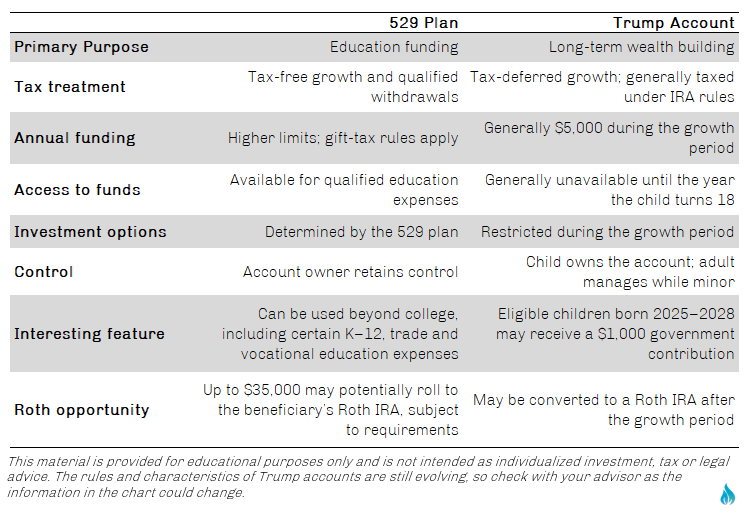
When the objective is education, a 529 is difficult to beat from a tax perspective. A Trump Account offers something different: the opportunity to begin investing for a child’s much longer-term financial future.
For families already maximizing other savings opportunities, there are several features of Trump Accounts worth considering beyond the initial $1,000 contribution.
Under a recently issued IRS safe harbor, qualifying contributions to Trump Accounts can be treated as completed gifts eligible for the annual gift-tax exclusion. Put simply, a $5,000 contribution generally uses $5,000 of the donor’s $19,000 annual exclusion in 2026. The government’s $1,000 contribution does not use any of the parent’s or grandparent’s annual exclusion.
There is also an important technical caveat for families with more complex estate plans: the IRS safe harbor has specific conditions and generally is not available when a donor is otherwise required to file a gift-tax return. Families already making significant annual or lifetime gifts should therefore coordinate Trump Account contributions with their estate-planning and tax advisors.
There has been a lot of discussion about the merits of opening these accounts. For me, the potential for a future Roth conversion made the account more compelling as a long-term planning opportunity for my family.
After the childhood growth period ends, Trump Accounts generally become subject to traditional IRA rules, including the rules governing Roth conversions. Contributions made by parents or grandparents generally create after-tax basis in the account. Investment gains and the $1,000 government contribution generally do not. A future Roth conversion could therefore result in income tax being due on the untaxed portion of the account, while amounts representing basis would generally not be taxed again.
Consider a simple example. A young adult finishes college and has relatively low income during the first years of their career. If a portion of the Trump Account is converted to a Roth IRA during that period, income tax may be due on the taxable portion of the conversion. But once those assets are in the Roth, they could potentially remain invested for another 50 years, with qualified Roth withdrawals ultimately received tax-free.
In other words, the planning opportunity is essentially:
For a child receiving contributions from a very young age, the compounding effect of tax-free asset growth could be significant.
The fact that a Roth conversion becomes available does not mean it should automatically happen as soon as the child turns 18. The family situation and timing matters.
While it’s true that a child’s federal tax rate may be its lowest at age 18, converting immediately may not always be optimal, particularly for a full-time student who remains subject to the kiddie-tax rules.
For those affected, the taxable portion of the conversion could be taxed at the parents’ tax rate rather than the child’s lower rate. This can apply through age 23 for certain full-time students who do not provide more than half of their own support from earned income. As a result, the most attractive Roth conversion window may come after college, when the child is no longer subject to the kiddie tax but before their own earnings have risen significantly.
Allowing a young adult to control a potentially meaningful pool of assets may also concern some families. I regularly see parents wrestle with how much financial security to provide without removing the pressure and incentive for their kids to create their own wealth. They may also worry that their children will make poor financial decisions if given too much control.
While both are legitimate concerns, I personally view this as an opportunity to educate my kids about investing, compounding and financial discipline using assets that directly affect their own future.
Not necessarily. In my view, each account serves a very different purpose. A parent looking to save for a child’s education while also creating a tax-efficient pool of assets for their longer-term financial future may find that a 529 plan and Trump Account can complement one another.
There are, however, some important gift-tax considerations before contributing to a Trump Account. In particular, families should consider:
For families with more substantial gifting programs, this makes coordination with their tax and estate-planning advisors especially important before simply adding another account contribution.
For my own family, I think a lot about balancing rising family-related expenses while providing long-term security for my kids. Optimizing after-tax wealth is what I seek to accomplish for our clients, so it’s natural that I would explore similar options for my own family. For those reasons, my wife and I will be contributing to both types of accounts in addition to the $1,000 government contribution that my youngest qualifies for. How I balance contributions between their 529 plans and Trump Accounts is still a question, but I anticipate focusing more heavily on their education savings until I feel they are appropriately funded.
Ultimately, the greatest advantage these accounts may offer is time: the earlier children begin investing, the longer compounding has an opportunity to work in their favor.

Michael is the founder of Fire Capital Management.