
Written by
Kelsey Syvrud, PhD
Written by
Kelsey Syvrud, PhD
Published on
August 13, 2026
Category
Investment Insights
Index investing has made diversified market exposure cheaper and more accessible than ever. But as passive investing has grown and indexes have evolved, the passive investment strategies an investor selects can introduce meaningful differences in security, sector, country, and factor exposure, leading to unintended bets and deviations in expected portfolio performance.
For much of the past several decades, one of the most important changes in investing has been the movement toward passive strategies. The appeal is easy to understand. An index fund seeks to replicate a predefined benchmark, which can provide investors with broad market exposure at relatively low cost and with a transparent investment process. But the success of index investing has also encouraged a shorthand that can sometimes obscure what investors actually own. We often speak about an allocation as though the key decision is simply active versus passive.
In reality, passive investing removes one type of decision: the ongoing discretionary decision about which individual securities a portfolio manager wants to buy or sell. It does not eliminate decisions about what constitutes the investable market, which securities qualify for inclusion, how those securities are weighted, how quickly new companies enter the portfolio, how countries are classified, or whether companies must satisfy profitability or other eligibility requirements. Those decisions simply happen somewhere else.
In an actively managed portfolio, many of them are made by the portfolio manager. In an index strategy, many are embedded in the benchmark methodology before the investor ever purchases the fund. This distinction matters more today because the index landscape is no longer composed of a handful of broadly similar market benchmarks. Investors can choose among market-cap-weighted indexes, equal-weighted indexes, total-market indexes, style indexes, factor indexes, sector indexes, dividend indexes and numerous other variations. Two funds can both carry a familiar label such as U.S. large cap, while owning meaningfully different portfolios.
At the same time, some major benchmarks have become highly concentrated in a relatively small number of companies and sectors. Other index providers have changed their methodologies to accommodate mega-cap newly public companies. International benchmark providers continue to disagree about whether certain countries belong in developed or emerging markets. And indexes targeting the same capitalization segment can embed very different profitability and quality characteristics.
The implication is not that index investing has somehow stopped working. It is that “passive” should not be confused with “neutral.” A passive fund may follow its benchmark automatically; however, the benchmark itself represents a series of choices. As those choices become more consequential, investors should understand them.
The rise of passive investing is one of the great structural changes in asset management. Index mutual funds first appeared in the 1970s, followed by index ETFs in the 1990s. By the end of 2010, index-tracking mutual funds and ETFs (i.e., “passive” funds) represented approximately 19% of long-term fund assets. By the end of 2025, that share had climbed to 52%, with approximately $19.3 trillion invested in index mutual funds and ETFs.
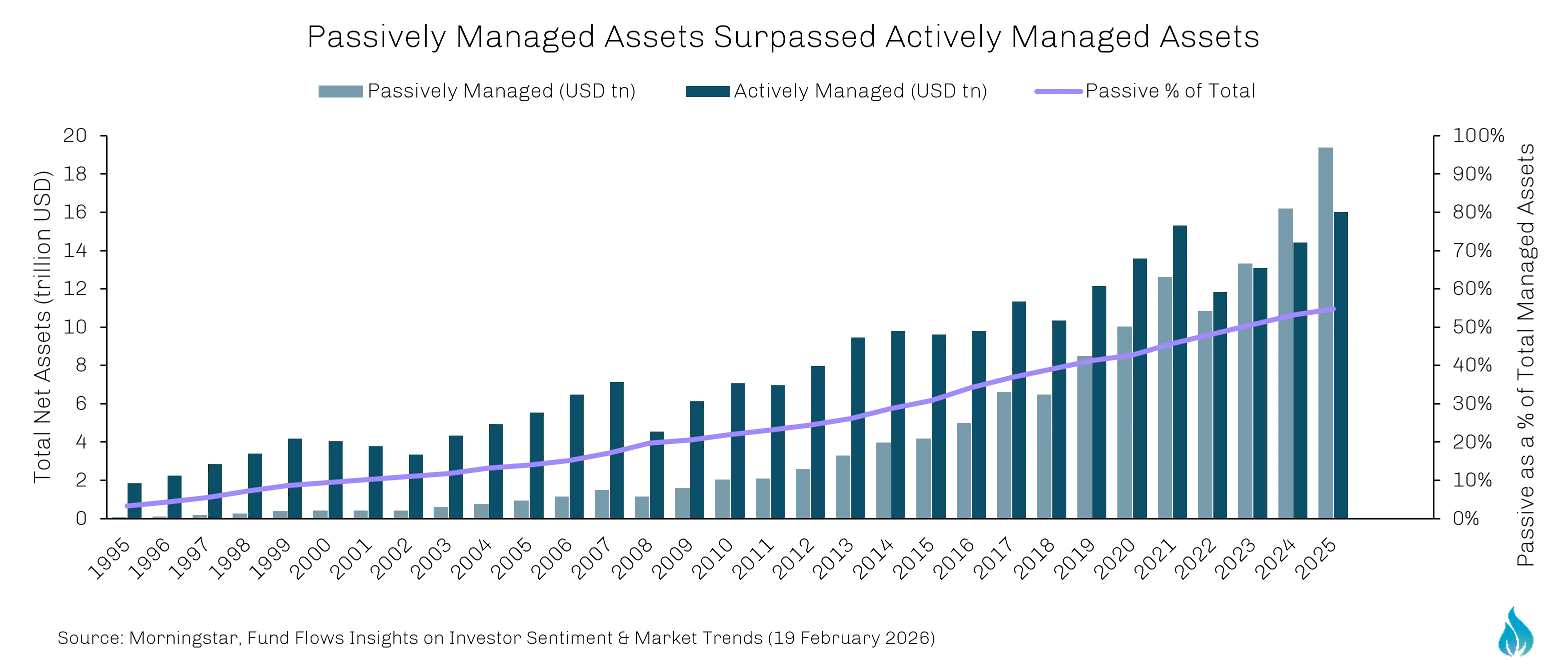
Flows show that the transition remains ongoing rather than merely historical. During June 2026 alone, domestic-equity index mutual funds and ETFs recorded approximately $65.3 billion of net inflows, while their actively managed counterparts experienced approximately $24.4 billion of net outflows. While one month's flows should not be interpreted as a forecast, they do illustrate the magnitude at which investors now use index strategies.
Cost has been an important part of the story. ICI estimates that the asset-weighted average expense ratio of index equity mutual funds was only 0.05% in 2025, compared to 0.64% for actively managed equity mutual and approximately 0.14% for index equity ETFs. These are industry averages, but the direction is clear: investors can now obtain broad equity exposure very inexpensively.

Just as important, the number of choices has expanded. As of June 2026, there were approximately 2,590 long-term index mutual funds and ETFs, including 1,361 domestic-equity index products. When the passive choice was effectively buy a broad-market index fund, passive investing could reasonably be thought of primarily as a decision to avoid active stock selection. With thousands of index products available, investors now face a second decision: Which systematic exposure should they own?
That decision can involve considerably more than expense ratio. The increasing popularity of index investing therefore creates an interesting paradox: Passive implementation has become easier but passive selection has become more important. This distinction is especially relevant for portfolios that are formed off multiple index-based building blocks. Selecting one index rather than another can alter the portfolio's exposures before any subsequent asset-allocation decision is made.
That does not diminish the importance of cost. Fees are one of the relatively few investment variables that investors can know in advance, and the long-term decline in investment-product expenses has been a significant benefit for investors. However, once several products all offer inexpensive implementation, cost alone does not tell us whether those products are providing the same exposure. Increasingly, they are not.
It is tempting to think of an index as though it simply exists, but in practice, an index must be constructed. Someone must define which securities are eligible. The provider must decide how U.S. domicile is determined, how much public float is necessary, whether multiple share classes qualify, how liquidity is measured, how corporate actions are handled, how frequently the portfolio is reconstituted, and what happens when securities no longer satisfy the methodology.
Then there is the question of weighting. Market-capitalization weighting gives the largest market values the largest portfolio weights. Equal weighting gives each company approximately the same weight at each rebalance. Fundamental or factor strategies can weight companies according to other characteristics. Each methodology is systematic, but each produces a different portfolio. That is why describing an investment simply as passive U.S. equity conveys much less information than it once did.
A useful conceptual distinction is between active and systematic investing. In that framing, active management involves security selection or market timing based on manager judgment, while systematic investing follows a defined ruleset. Index funds are systematic because a methodology governs implementation even though the end investor is not selecting stocks individually.
An example of this can be found in one of the most known indexes: the S&P 500. The S&P 500 is certainly an index, and funds tracking it are reasonably described as passive investment vehicles. But the index itself is not simply a mechanical list of the 500 largest U.S. companies. S&P's U.S. index family is maintained by an Index Committee. The committee meets monthly, reviews companies being considered for addition, monitors significant market events and may revise index policies. S&P's methodology also states that its committees may make exceptions in applying the methodology when circumstances warrant. That does not make an S&P 500 index fund an actively managed mutual fund in the conventional sense. The portfolio manager of an S&P 500 ETF is not making independent decisions about whether NVIDIA, Apple or Microsoft should be overweight or underweight. But it does illustrate an important point: Security selection can occur upstream.
FTSE Russell uses a somewhat different philosophy for its core Russell U.S. benchmarks. In explaining Russell 1000 and Russell 2000 membership, FTSE Russell emphasizes objective eligibility rules and market-cap ranking rather than a committee selecting companies. Neither methodology is inherently better simply because one incorporates more committee governance and the other is designed to be more mechanical. But they are different, and these differences can determine whether investors own a company, when they begin owning it, and how much exposure they ultimately receive.
The same applies to weighting methodology. The traditional S&P 500 is float-adjusted market-cap weighted, meaning larger companies receive larger weights. The S&P 500 Equal Weight Index holds the same constituent universe but resets companies to roughly equal weights each quarter. S&P itself notes that equal weighting consequently introduces a smaller-size bias, a value orientation and an anti-momentum characteristic relative to the capitalization-weighted S&P 500. This is an excellent example of why there is no perfectly neutral answer. An investor concerned about mega-cap concentration can choose equal weighting. In doing so, they are replacing one weighting methodology with another and accepting the systematic tilts created by that alternative. Portfolio construction always involves trade-offs and indexes simply encode those trade-offs into rules.
Perhaps nowhere is the distinction between diversification and neutrality more visible today than in U.S. large-cap equities. An investor purchasing an S&P 500 fund receives exposure to hundreds of companies spanning many sectors. By security count, that sounds broadly diversified. But diversification by number of holdings is not the same as diversification by portfolio weight, and neither necessarily means that every company or sector contributes equally to portfolio risk and return.
If several of the largest-performing companies are concentrated in related areas of the market, the benchmark naturally becomes more concentrated in those companies and sectors. No index committee needs to make a tactical decision to overweight them; capitalization weighting does it automatically as relative market values change.
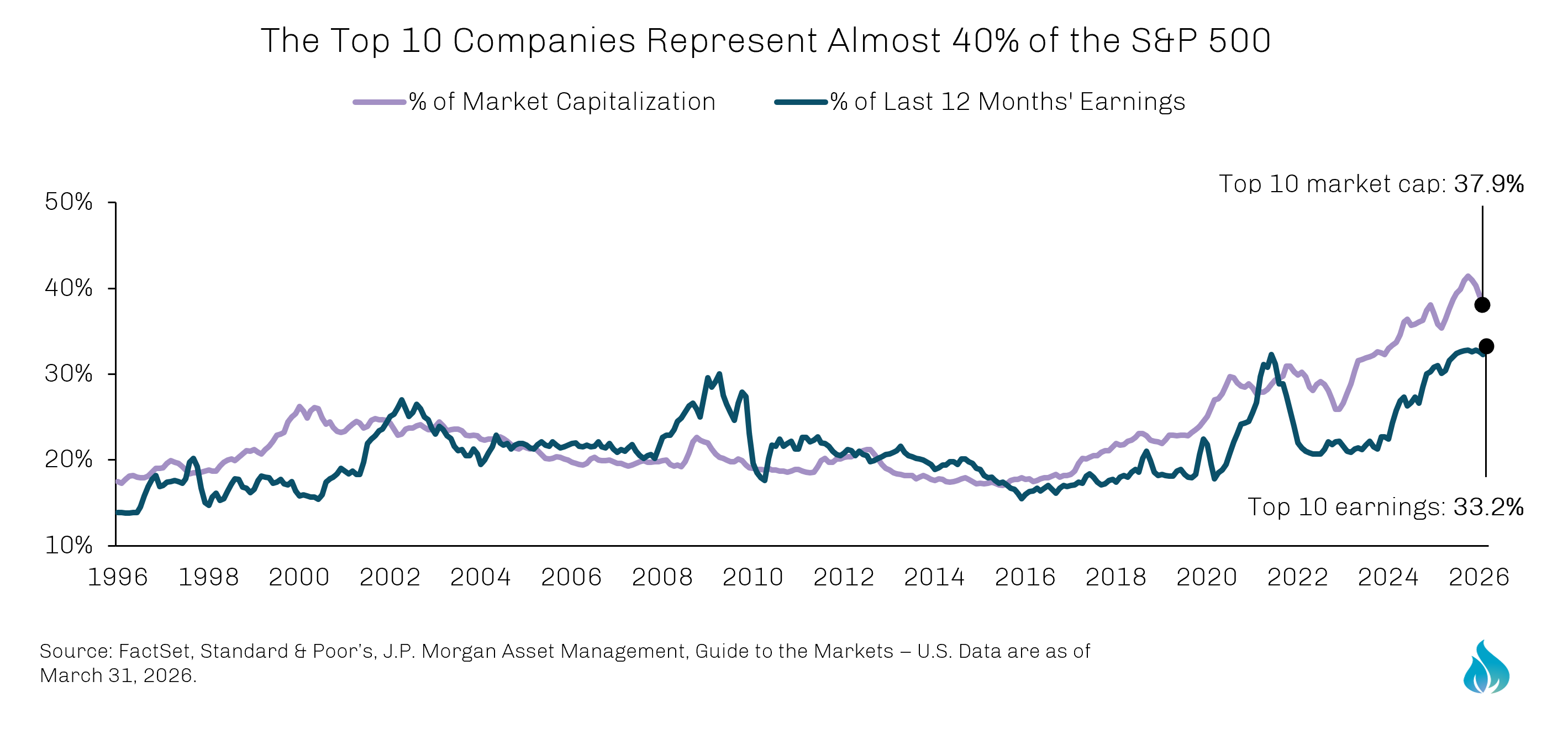
The effect has become significant. As of March 31, 2026, the ten largest companies represented nearly 40% of the S&P 500. Concentration was even more pronounced within the Russell 1000 Growth Index, where the ten largest companies represented approximately 61% of the benchmark.
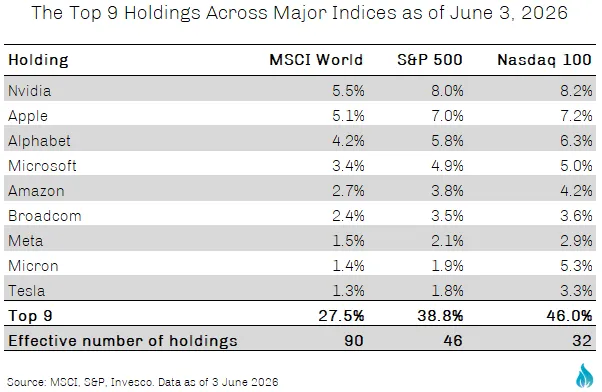
The sector picture is similarly striking. As of June 30, 2026, the SPDR S&P 500 ETF Trust, which seeks to track the S&P 500, reported 38.03% of the portfolio in Information Technology. Financials, the second-largest sector, represented 11.76%. At the individual-security level, NVIDIA represented 7.50% of SPY at June 30. The point is that an investor who says, “I own ~500 companies, so I am broadly diversified,” may be describing the number of securities correctly while overlooking the economic distribution of the portfolio.
Company concentration is only one way that indexes can differ. A second, increasingly important distinction is constituent eligibility. Investors often assume that two broad U.S. large-cap indexes should contain essentially the same important companies. Historically, the overlap has often been substantial enough that the distinction received relatively little attention from individual investors.
The 2026 IPO market has made that assumption harder to maintain. On May 26, 2026, FTSE Russell changed the IPO inclusion framework for its Russell U.S. Index Series. Under the enhanced methodology, newly public companies with investable market capitalizations exceeding the market-adjusted Russell Top 500 breakpoint can become eligible for fast entry. An eligible fast-entry IPO can then be added after the close of its fifth trading day.
The rationale is straightforward. If an exceptionally large company becomes public, waiting months for a normal index review can leave a benchmark that is intended to represent the U.S. investable market without one of its largest publicly traded companies. The new rule became immediately relevant with Space Exploration Technologies (i.e., SpaceX). SpaceX entered the Russell 1000 as a fast-entry IPO. The addition was announced June 12, with the June reconstitution changes effective after the market close on June 26.
An investor in an S&P 500 index product faces a very different rulebook. In 2026, S&P Dow Jones Indices considered changing its rules for very large newly public companies. Among the proposals was reducing the IPO seasoning requirement from 12 months to six months and making certain other exceptions for mega-cap companies. However, in June, S&P decided not to make those changes for their indices, retaining its existing financial-viability screens, seasoning requirement and minimum investable-weight requirements. As a result, SpaceX is not currently included in the S&P 500 index.
Now consider the portfolio implications of this example. An investor owning a Russell 1000-tracking strategy received systematic exposure to SpaceX shortly after its public listing because FTSE Russell's methodology was specifically changed to accommodate sufficiently large IPOs. An investor tracking the S&P 500 did not receive that same exposure, because S&P's methodology intentionally requires a longer seasoning period and other eligibility criteria. Neither investor made an individual security-selection decision. Yet one investor owns the company and the other does not. That is an active portfolio consequence produced by two passive methodologies.
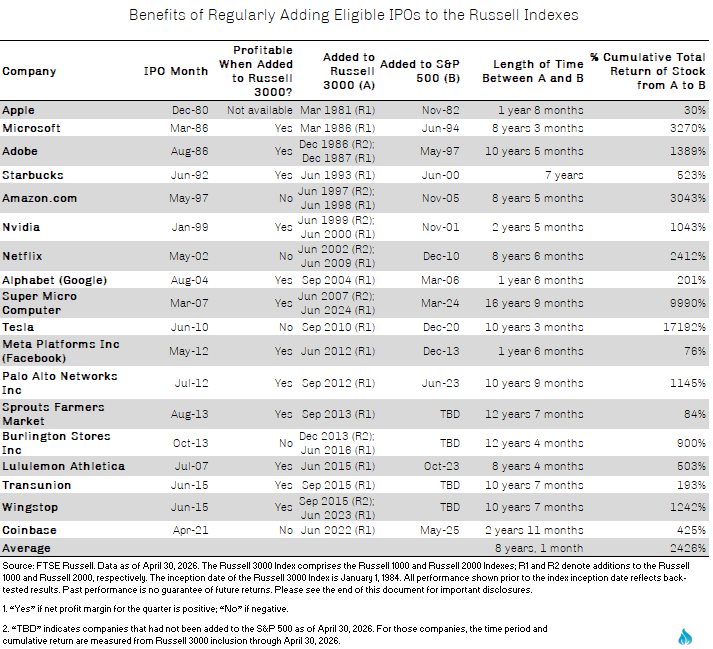
This is particularly important when newly public companies are very large. If a relatively small IPO represents only a few basis points of a broad index, differences in inclusion dates may have limited portfolio impact. If a newly public company is potentially one of the largest companies in the U.S. market, as was the case with SpaceX and several other private firms looking to go public in the near future, the decision about whether the index owns it can become much more consequential. This is another reason why simply picking an index tracking ETF and saying you own U.S. large cap is increasingly incomplete. Which definition of U.S. large cap are you using?
The issue becomes even more visible in international investing because index providers sometimes disagree about something as basic as which countries belong in an asset class. South Korea is one of the clearest current examples.
As of its April 2026 country-classification review, FTSE Russell continued to classify South Korea as a developed market. That classification flows directly into products using FTSE benchmarks. The Vanguard FTSE Emerging Markets ETF (VWO), for example, seeks to track a FTSE Emerging Markets Index. Vanguard describes the portfolio as passively managed using index sampling, with substantially all assets invested in securities included in the index. The fund has approximately 6,300 holdings, but South Korea was not a benchmark country allocation because FTSE classifies it as developed rather than emerging.
Compare that with the iShares Core MSCI Emerging Markets ETF, IEMG, which follows an MSCI emerging-markets benchmark. As of June 30, 2026, South Korea represented 22.50% of IEMG. Samsung Electronics alone represented 7.15% of the fund, while SK Hynix represented 6.70%.
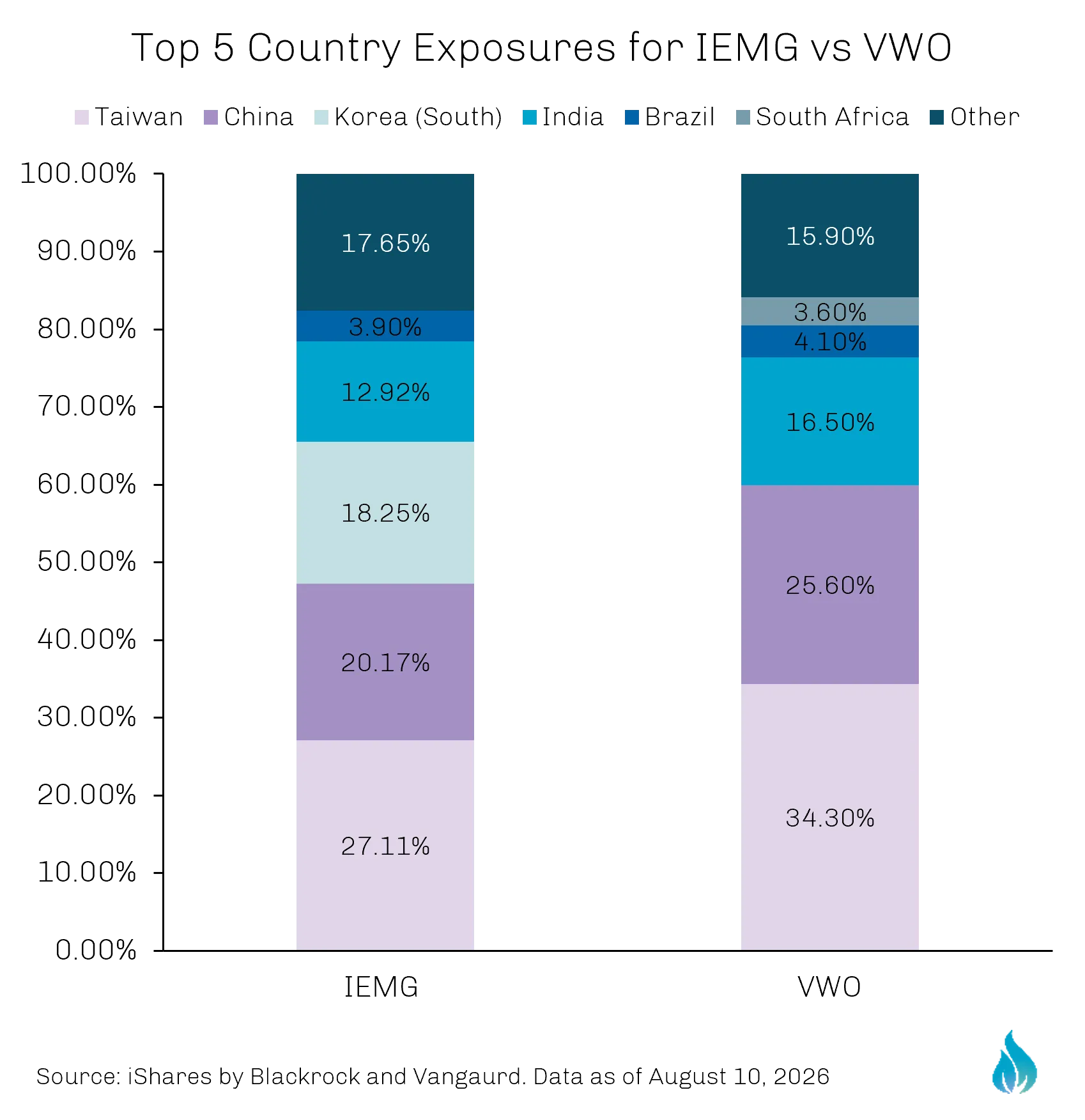
Think about how meaningful that difference is. Two funds can each say they represent a broadly diversified, low-cost emerging-markets index ETF. One owns more than 6,000 securities and has no South Korea benchmark allocation. Another owns nearly 3,000 securities and has more than one-fifth of the portfolio in South Korea. Both statements about being broadly diversified emerging-markets investors sound reasonable, however they describe very different portfolios and can result in vary different performance results.
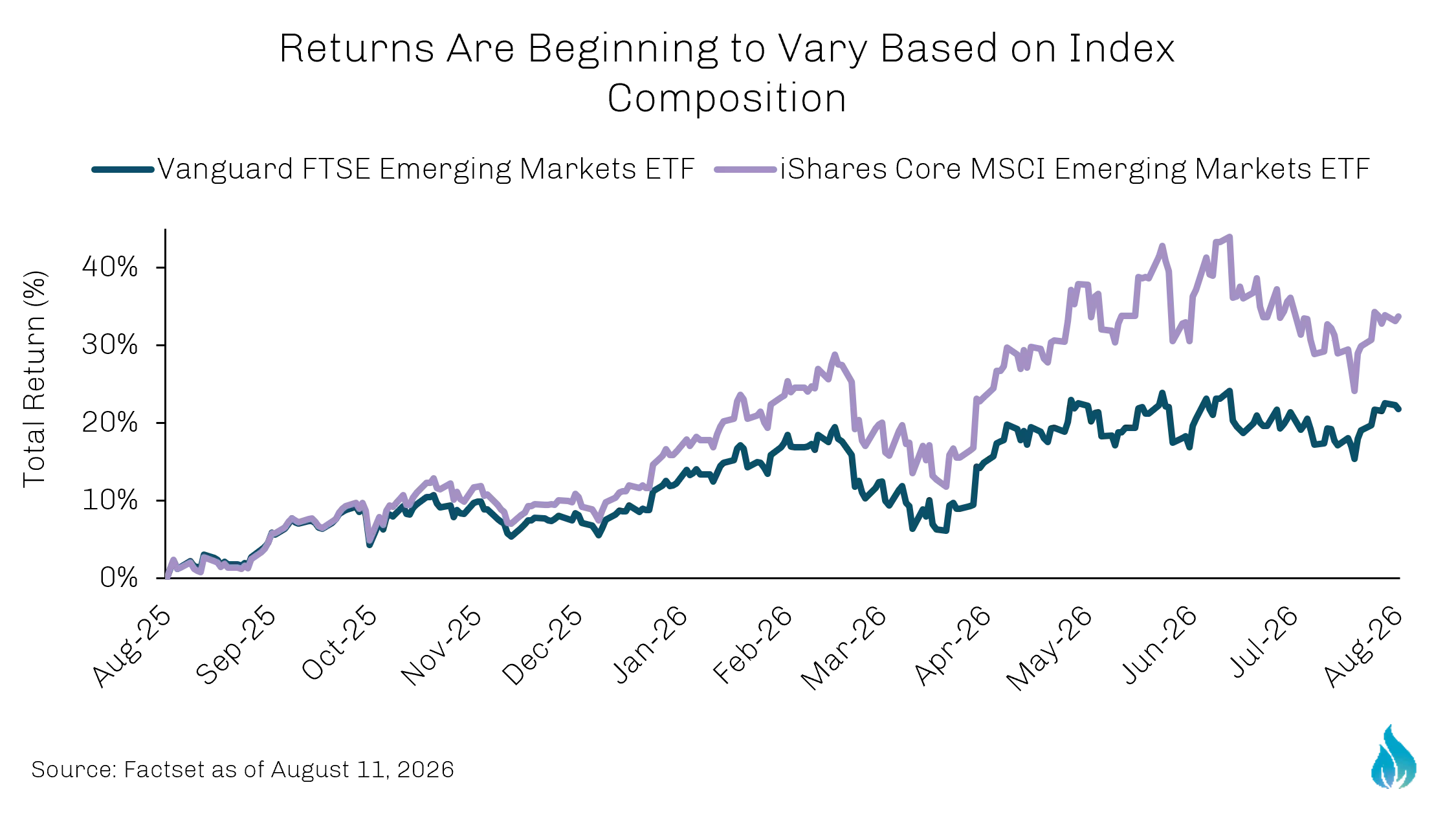
The differences do not stop at country weight. Because Samsung Electronics and SK Hynix are major semiconductor companies, the decision to include South Korea also changes the underlying security composition of the portfolio. As a result, country methodology can cascade into sector and security exposures as well. This is the kind of exposure that can remain invisible if portfolio construction stops at the fund name. Again, the lesson is not that FTSE is correct and MSCI is wrong, or vice versa. The lesson is that the investor is choosing between them. That choice can lead to a 20%+ portfolio decision without the client ever explicitly saying, I want to overweight or underweight South Korea. That is what we mean by an unintentional bet.
Even when two index providers agree on the country and approximate capitalization segment, their construction rules can produce different exposure to investment factors. U.S. small-cap equities provide an excellent example. The Russell 2000 and S&P SmallCap 600 are both widely used benchmarks for U.S. small-cap stocks. An investor looking at the names alone could reasonably assume that funds tracking the two benchmarks are interchangeable implementations of the same idea. They are not.
FTSE Russell describes the Russell 2000 as approximately 2,000 of the smaller companies within the Russell 3000 universe, with membership driven primarily by market capitalization, eligibility requirements and existing index membership. Its objective is to provide broad representation of the U.S. small-cap segment. In contrast, the S&P uses a different approach for entry into universe. A candidate generally must have positive GAAP net income in the most recent quarter and positive aggregate GAAP net income over the previous four quarters, in addition to satisfying other eligibility standards. That profitability requirement creates a systematic difference in the investable universe.
A company can be a publicly traded U.S. small-cap stock and meet the relevant Russell eligibility and capitalization criteria while being unprofitable. That company may appear in the Russell 2000 while failing the financial-viability requirements necessary for entry into the S&P 600. S&P Dow Jones Indices has explicitly described the consequence of its earnings screen as a quality-factor exposure relative to the Russell 2000.
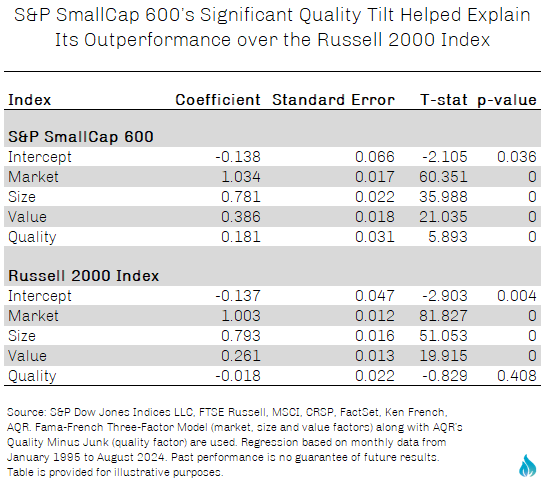
An investor buying the S&P 600 may think the primary decision is to get exposure to small-cap companies, but embedded inside that allocation is another decision: do you want your small-cap benchmark to impose a profitability screen?
Profitability and quality characteristics are not uniformly rewarded in every market environment. A portfolio that systematically excludes unprofitable businesses may behave differently from one that represents them more broadly. At other times, speculative or early-stage companies without current profits may perform strongly.
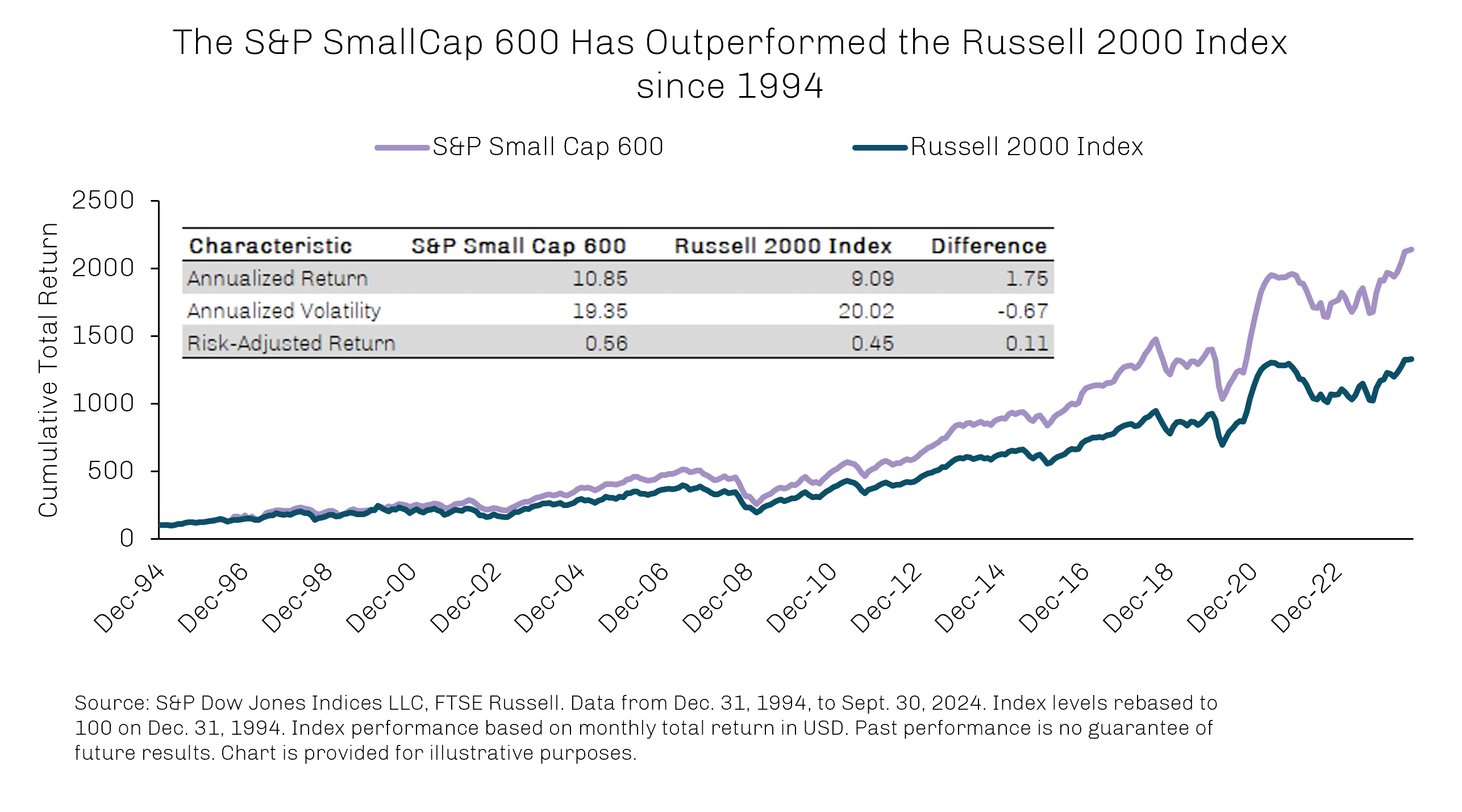
This is also why performance comparisons between index products need context. If two small-cap strategies have materially different profitability exposures, some difference in their historical returns may represent factor exposure rather than better or worse implementation.
This ties back to the broader active-versus-systematic distinction. Comparing strategies without accounting for their underlying systematic factor exposures can cause investors to attribute results to security-selection skill when they may instead reflect differences in the portfolio's rules and eligible universe.
This concept extends well beyond small caps. Whether it is a value fund, growth fund, low-volatility fund, dividend fund, etc., in each case, the portfolio remains systematic. Each will have a methodology that is expressing an investment view about which characteristics should determine inclusion or weight. Calling all of those portfolios’ “passive” is technically understandable, but it is not always analytically sufficient.
Taken together, these examples reveal the central problem with treating passive investing as a single portfolio category. All of them can accurately describe what they are doing as passive index investing. However, they are not making the same investment decisions. This is why the old idea that passive investing means buying the market deserves more scrutiny. There is no investable object simply called “the market” until someone defines it.
The rapid proliferation of index vehicles means investors now have more ability than ever to fine-tune the answer to what the market is. That is a significant advantage of modern markets. But flexibility creates responsibility. When there were only a few index choices, the differences among them could more easily be overlooked. With thousands of index products available, choosing the benchmark is increasingly part of the investment process itself. The word passive describes how the strategy is implemented, but it does not fully describe what the strategy owns.
This suggests a more useful way to evaluate passive investments. The fees, tracking efficiency, liquidity, and quality of the fund sponsor and implementation all still matter. But before any of those questions, there is a more fundamental one: What exposure are you actually buying? For a passive strategy, we believe that means understanding several dimensions of the benchmark including universe and inclusion, weighting, concentration, country methodology, factor exposure, and portfolio interaction (i.e., does the underlying holdings duplicate exposures already present elsewhere in the client's portfolio?) These questions allow investors to use passive strategies more deliberately. The distinction should be intentionality. An exposure is very different when it is owned because the portfolio construction process called for it rather than because nobody looked underneath the benchmark.
None of this is an argument against passive investing. The important lesson is not that one benchmark provider has discovered the objectively correct answer. It is that benchmark construction involves choices and investors inherit those choices. That is why we believe the familiar active-versus-passive debate can sometimes be less useful than it appears. The primary question becomes what risks and exposures does the portfolio actually contain?
The rise of passive investing has been overwhelmingly associated with simplification. In many ways, it has delivered exactly that. Investors no longer need to select an individual stock portfolio simply to participate broadly in equity markets. Portfolio implementation has become easier, more transparent and, in many cases, dramatically cheaper. But there is a difference between making implementation easier and eliminating portfolio decisions. As passive investing has matured, those decisions have moved upstream. Investors may mistake the absence of discretionary stock selection for the absence of active exposure decisions. These are not reasons to avoid indexing, but they are reasons to understand it.
At Fire Capital Management, our focus is not simply on whether a portfolio building block is labeled active or passive. We believe portfolio construction begins with understanding the exposures a strategy contributes to the total portfolio, determining whether those exposures are intentional, and considering how they interact with everything else an investor owns. Passive investments can play an important role in that process. But passive does not mean neutral and choosing which index to follow is still an active portfolio decision.


.webp)