Written by
Michael J. Firestone, CFA
Written by
Michael J. Firestone, CFA
Published on
October 8, 2026
Category
Market Trends & Commentary

The U.S. economy remains resilient entering the fourth quarter, supported by strong earnings, healthy consumer spending, and continued AI-related investment. However, the setup for 2027 is becoming more complicated as interest rates rise, fiscal support fades, inflation pressures remain elevated, and more of the economy and market become tied to a relatively narrow group of growth drivers.
While growth expectations continue to rise, there has been a shift directionally in certain key variables that have supported our positive outlook for the market in 2026. To be clear, the data does not support the idea that a recession is on the horizon. That said, rising structural risks argue for continued portfolio recalibration, diversification, disciplined rebalancing, and greater attention to areas where market expectations may be most vulnerable.
1. The economy remains strong, but the market setup is becoming more challenging. Higher rates, fading fiscal support, persistent inflation pressures, and high expectations create a less forgiving backdrop heading into 2027.
2. Higher rates may matter more with time. The economy has absorbed tighter policy remarkably well, but refinancing, adjustable borrowing, and another potential hiking cycle could increase pressure as we move further into 2027.
3. AI remains both a major growth engine and an emerging structural risk. AI investment continues to support economic growth and earnings, but the scale of spending, financing, and interconnected commitments is increasing financial complexity across the ecosystem.
4. The eventual AI risk may come from execution rather than the technology itself. A meaningful disruption could begin if one important participant gets ahead of its skis financially, creating an asset-liability mismatch that forces investors and counterparties to reassess broader exposures.
5. We are recalibrating portfolios, not retreating from markets. We continue to maintain exposure to long-term growth opportunities while rebalancing equity gains, broadening diversification, taking advantage of more attractive bond yields, adjusting rate-sensitive exposures, and evaluating potential hedging strategies.
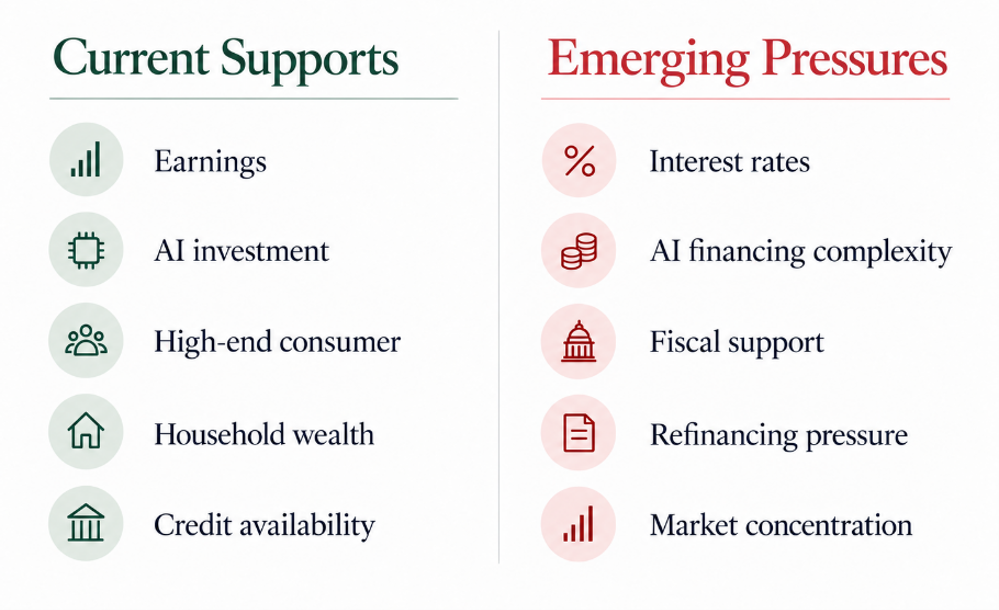
The U.S. economy enters the fourth quarter in a relatively strong position. Growth has remained resilient, corporate earnings have been very strong, unemployment remains low, and AI-related investment continues to support capital spending across a growing list of industries. Equity markets have also held up remarkably well despite higher interest rates, elevated energy prices, continued geopolitical uncertainty, and a Federal Reserve that has shifted back toward tightening. From an economic perspective, this still does not look like an economy on the edge of recession.
The market setup going into 2027 gives us more pause. Higher rates have not broken the economy, but they are beginning to matter more. Energy prices have stayed higher for longer than we originally hoped. Fiscal support should become less helpful next year. Housing remains challenged, refinancing costs are becoming more relevant, and an increasingly large portion of economic growth, corporate earnings, and market performance is tied in one way or another to AI investment.
Some of this builds on themes we have discussed for several years. In 2024, we wrote about why changes in the economy could allow monetary policy to take longer to work than investors had become accustomed to. We have also spent years focusing on secular growth themes driven by technological advancement. Those ideas increasingly intersect today. The economy has been remarkably resilient, but some of the same forces extending the cycle may also allow financial imbalances to build for longer before becoming obvious.
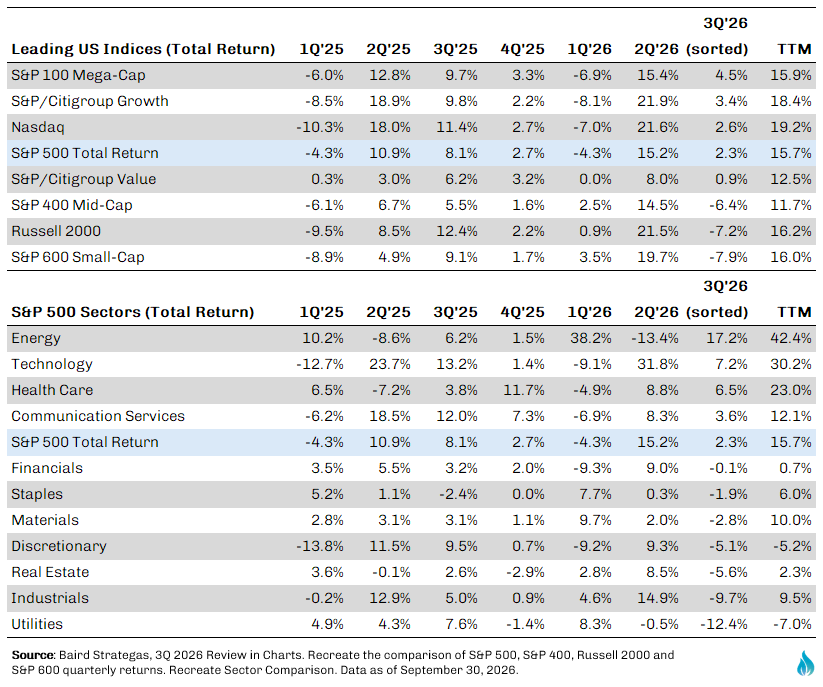
The third quarter was another good example of why the headline market return figure can miss a lot of what is happening underneath. The S&P 500 returned 2.3% during the quarter, but smaller companies struggled. The S&P 400 Mid Cap Index fell 6.4%, the Russell 2000 declined 7.2%, and the S&P 600 Small Cap Index fell 7.9%. Sector performance was also unusually dispersed, with Energy, Technology, and Health Care advancing while several economically sensitive sectors declined.
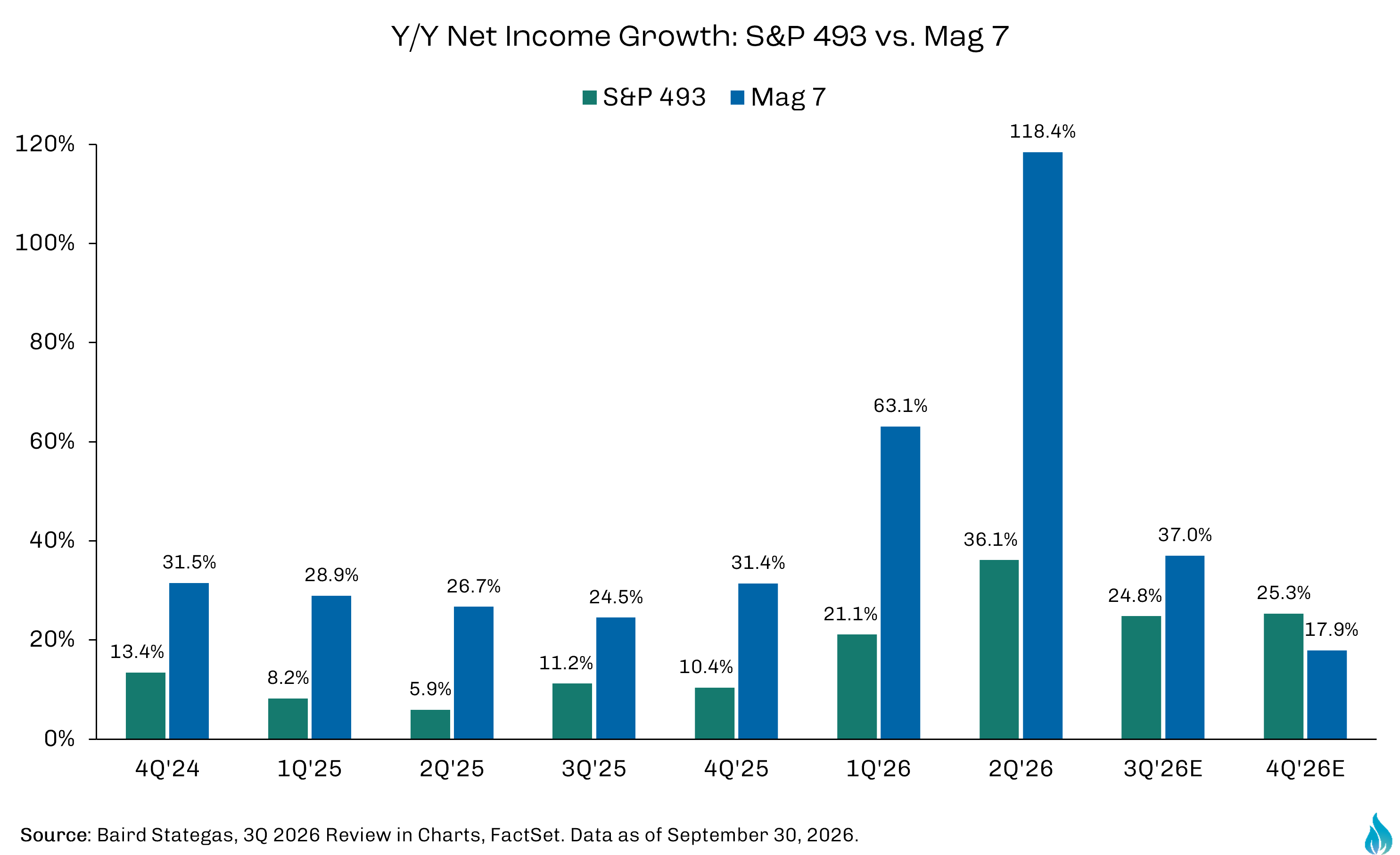
The market is also being supported by exceptionally strong corporate earnings. FactSet estimates third-quarter S&P 500 earnings growth near 30%, and one encouraging development is that earnings growth has broadened beyond the largest technology companies. Current estimates suggest the other 493 companies in the S&P 500 could actually outgrow the Magnificent 7 in the fourth quarter. We view that as an important positive.
Still, the market remains unusually concentrated. A broader definition of technology now represents roughly 53% of the S&P 500, while nearly half of the index's market capitalization can be classified as AI-related under one commonly used definition. Earnings breadth may be improving, but a large amount of market value, capital spending, and investor expectations remains tied to a relatively narrow group of companies and themes.
Valuations are another part of the story. The forward P/E ratio has come down from its highs, which is constructive, but several other commonly followed valuation measures remain elevated relative to much of their historical ranges. This does not necessarily tell us markets are overvalued, but it does mean the starting point is not especially forgiving if results begin to falter relative to expectations.
Fixed income is also beginning to send a more cautious message. The 10-year Treasury yield ended the quarter around 5.3%, while the 30-year Treasury moved to approximately 5.6%. High-yield spreads have widened, although they remain historically tight, and some signs of stress are appearing in portions of private credit. Credit markets are not flashing red, but there are more yellow flags than there were a few quarters ago. At the same time, investors are repeatedly reassessing the appropriate compensation for inflation, Fed policy, fiscal borrowing, energy prices, and growth. The result is a bond market that is less stable with heightened volatility.
One of the more impressive things about 2026 has been how well the economy has handled higher rates and higher energy prices. Years of extremely low borrowing costs allowed many households and businesses to lock in cheap, long-duration debt, delaying the normal transmission of tighter monetary policy, while modern energy efficiency standards and a growing mix of alternative energy sources have dampened the immediate impact of high oil prices on the economy.
The flip side is that a company with long-term debt does not refinance every quarter. A commercial real estate owner may not face the full impact until a loan matures. A household may be insulated until a floating-rate loan resets or another borrowing need arises. And a jump in gasoline prices may not be felt until credit card balances climb to uncomfortable levels. Higher rates and energy can therefore look surprisingly benign at first and increasingly consequential later.
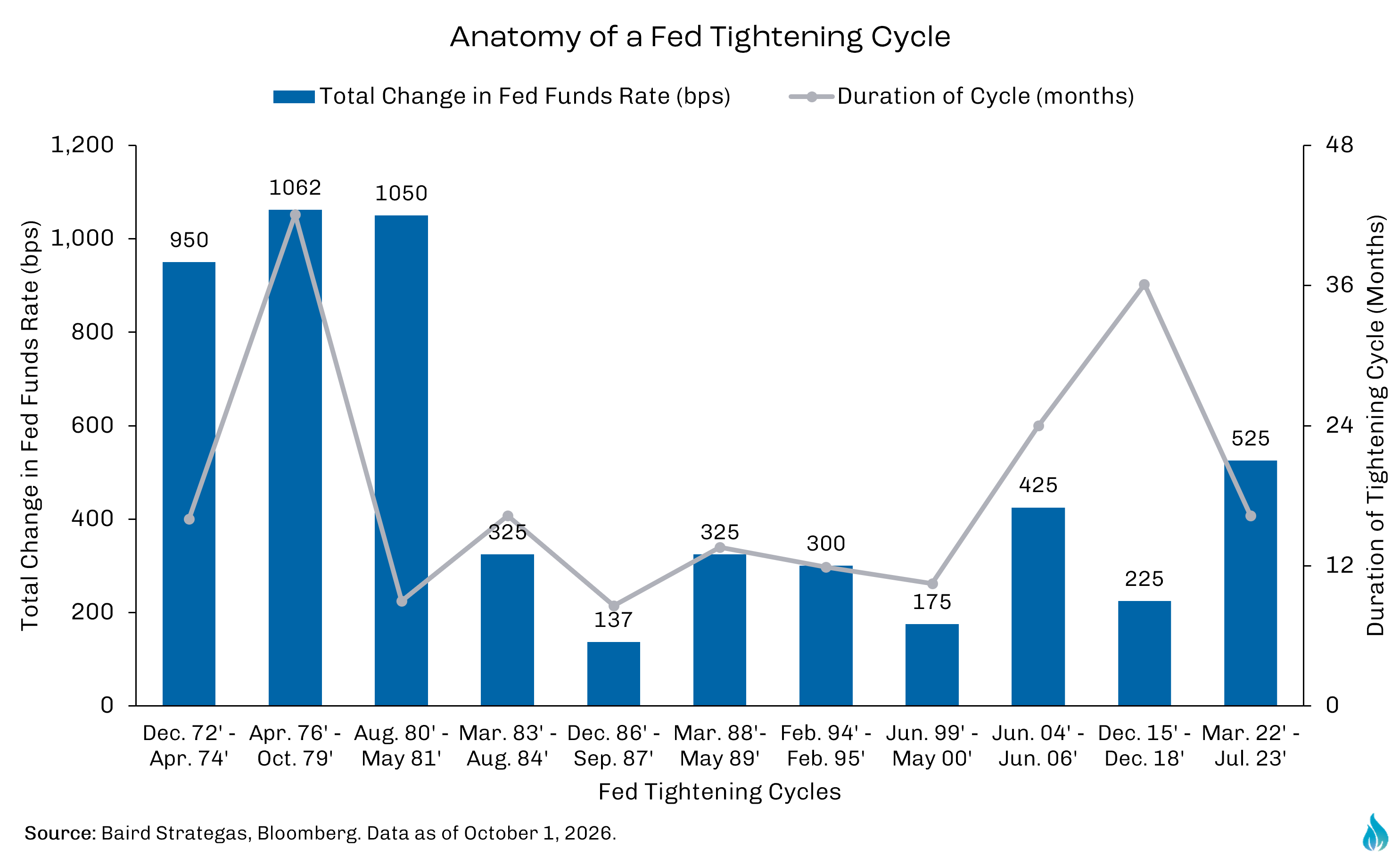
History also suggests investors should be cautious about assuming one rate hike will remain one rate hike. Strategas' review of prior tightening cycles shows that hiking campaigns generally lasted many months and involved substantially more cumulative tightening than the first few moves might have suggested. The lesson is simple: once a central bank decides inflation requires tighter policy, stopping can be harder than investors initially expect.
The stock market impact has been more mixed than simply saying stocks fall when the Fed hikes. Some historical tightening cycles ultimately produced positive equity returns, particularly when rate increases were gradual and the economy avoided recession. The path, however, was rarely smooth. Strategas calculates that the median maximum drawdown experienced sometime between the first and final rate hike across prior cycles was roughly 13.7%.
Long-term yields have also often continued rising after tightening begins. Across the cycles reviewed by Strategas, the 10-year Treasury yield rose on average by roughly 27 basis points after three months, 55 basis points after six months, and 93 basis points after twelve months following the start of a hiking cycle. That is not a forecast, but it is a useful reminder that the first Fed hike is not necessarily the point when financial conditions are at their tightest.
This matters because we entered 2026 expecting lower rates to become an increasingly important economic tailwind. Instead, long-term borrowing costs have moved higher and the Fed is tightening again. At the same time, fiscal policy should provide less help in 2027. UBS estimates that the 2025 tax legislation front-loaded much of its growth support into 2026, with the broader fiscal impulse fading quickly thereafter. ClearBridge Investments similarly estimates that the fiscal boost is roughly 1% of nominal GDP in 2026, falling to approximately 0.5% in 2027 and 2028.
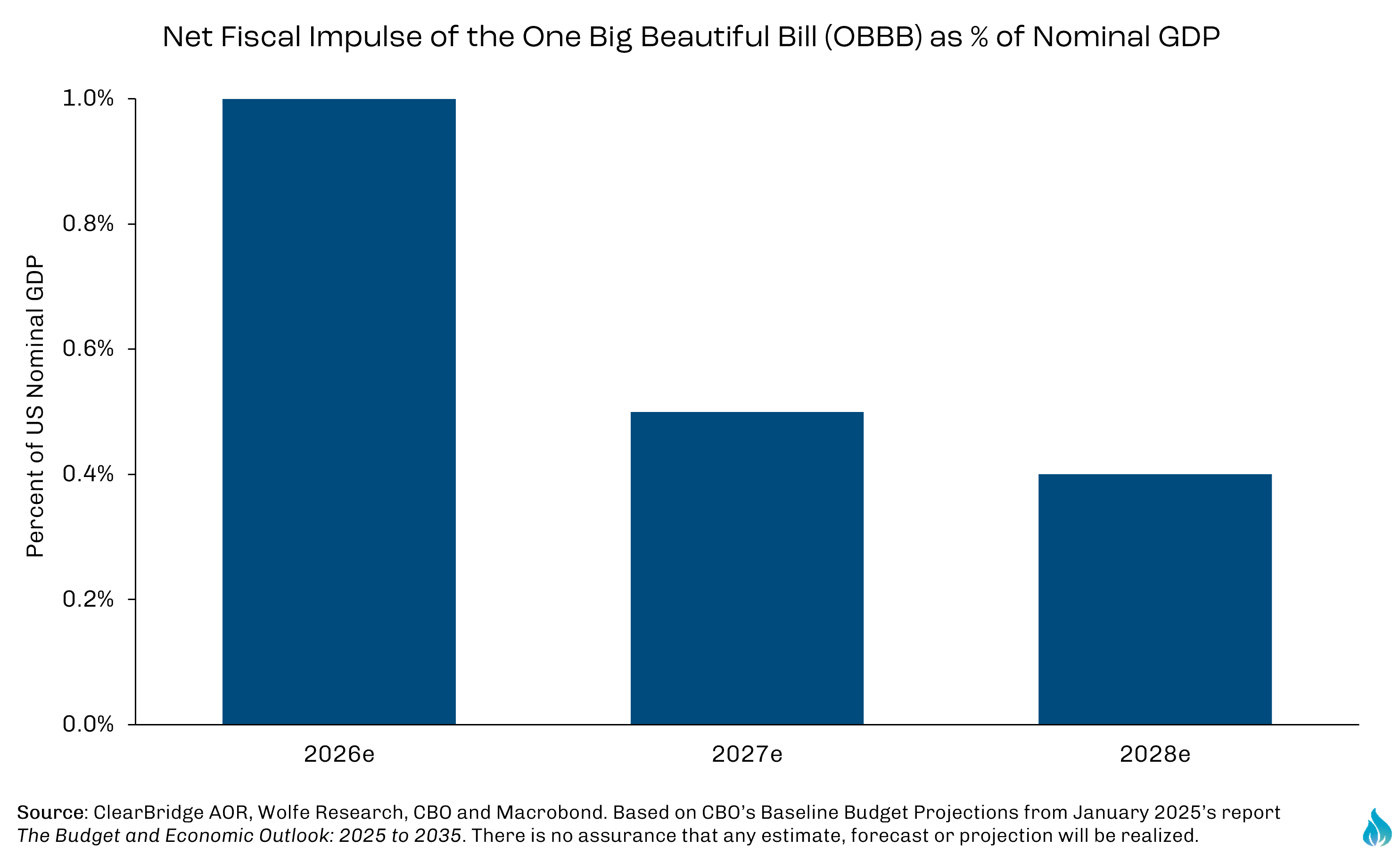
That does not mean fiscal policy suddenly becomes restrictive. It simply means one of the forces helping the economy absorb higher rates and higher energy prices this year should become less powerful next year.
We had hoped the inflation story would become simpler by this point in the year. Instead, the prolonged energy shock has made the outlook more complex. The encouraging part is that much of the recent pressure remains concentrated in more flexible components rather than the stickier categories that tend to persist. Through August, flexible-price inflation had moved close to 5%, while sticky inflation remained below 3%.
The less encouraging part is that energy affects much more than gasoline. Sustained higher oil and natural gas prices eventually filter into transportation, utilities, travel, food production, chemicals, plastics, shipping, and other costs. We have also seen anecdotal evidence of price increases outside energy, including technology hardware, subscription services, and childcare. None of this necessarily means another major inflation wave is beginning, but it makes the Fed's job more difficult at a time when nominal economic growth remains strong.
This leaves investors in a somewhat unusual position. Strong growth is obviously preferable to weak growth, but the economy may now be strong enough to keep monetary policy tight while the underlying sources of that strength are becoming more concentrated. Higher real rates, a rising term premium, large government borrowing needs, and enormous private-sector capital requirements for AI infrastructure are all competing for capital.
We think there is a useful comparison between the S&P 500 and the U.S. consumer. A relatively small number of very large companies can keep the index moving higher even when many other businesses are struggling. The consumer can work the same way. Overall spending can remain strong even if a meaningful portion of households are under pressure, provided wealthier households continue to spend.
Those households own a disproportionate share of financial assets and have benefited more from rising equity and real estate values. This is the wealth effect. When portfolios and property values rise, people tend to feel financially stronger and become more comfortable spending even if their current income has not increased by the same amount. The reverse can also happen.
UBS has a useful way of showing this. Its decomposition of recent U.S. growth shows AI investment and upper-income consumption providing much of the economy's incremental resilience, while other portions of the economy have been considerably less impressive. UBS also notes that equity holdings recently reached an all-time high share of household net worth.
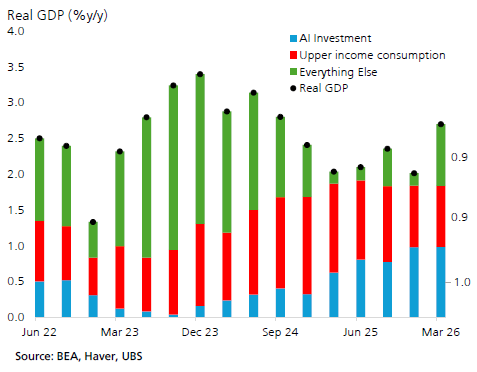
That makes the upper-income consumer particularly important today. One smaller issue we have been looking at is adjustable-rate mortgages. ARMs remain a relatively small portion of the overall mortgage market. However, they were used disproportionately by jumbo borrowers and owners of more expensive homes.
We had to piece the data together from several sources, so this should be viewed as a rough estimate, but our analysis suggests that up to roughly $100 billion of 2016 through 2021 ARM originations could reach their first reset during 2026 through 2028. The total is not large enough to create a systemic mortgage issue. What interests us more is the borrower.
For a wealthy household, a large reset is unlikely to create a traditional default problem. The more likely question may simply become whether an expensive second property is still worth carrying at the new cost. In some cases, selling the home could come before any meaningful reduction in everyday spending. The broader point is that higher rates are gradually reaching a consumer cohort that has been unusually important to economic resilience.
If there is one area where we think investors need to spend a disproportionate amount of time today, it is AI. We continue to believe the technology has enormous long-term potential. The harder investment question is:
How much money needs to be spent to keep advancing the technology, who ultimately earns an adequate return on that spending, and what happens if the rate of spending growth slows?
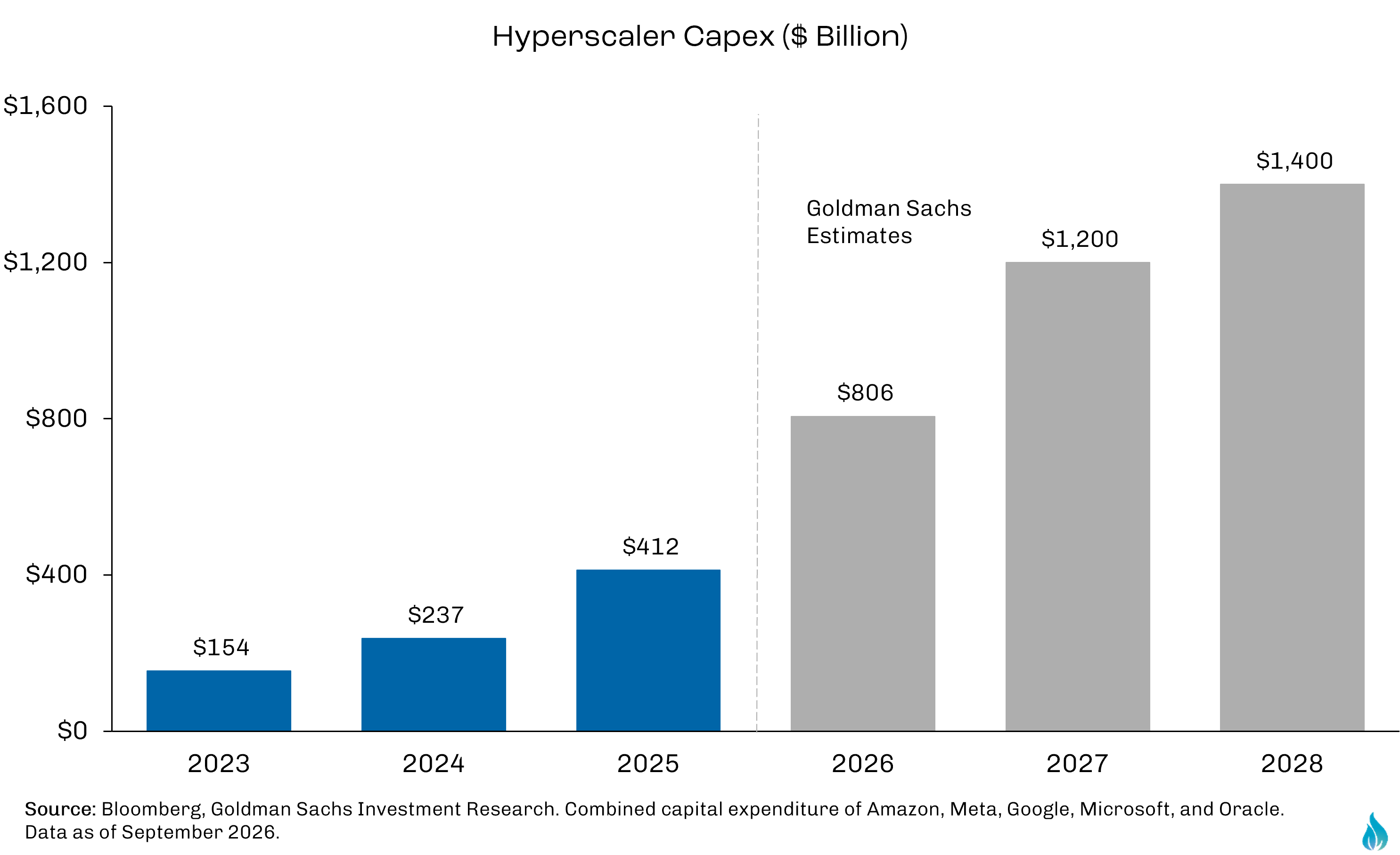
Capital spending shows no sign of slowing yet. Next-12-month S&P 500 capital expenditure estimates have climbed to roughly $1.84 trillion, while data-center construction continues to rise sharply. The buildout is also increasingly visible in broader economic data. Core capital goods orders were up nearly 13% year over year in July, while unfilled orders for computers and electronic products reached a record $158.9 billion. The largest hyperscalers are spending extraordinary amounts on semiconductors, servers, power, cooling, construction, networking infrastructure, and increasingly the financing structures required to tie those pieces together.
There are also signs that AI spending is broadening beyond the hyperscalers. Yardeni Research notes that Nvidia’s non-hyperscaler revenue grew 138% year over year in its latest quarter, outpacing 102% growth from hyperscaler customers, as demand expanded across AI-native companies, sovereign cloud projects, and traditional enterprise IT.
The problem is that the frontier-model race creates its own spending pressure. Remaining at the technological frontier requires enormous amounts of compute, data, experimentation, infrastructure, and capital. The largest model developers cannot simply decide that today's capabilities are good enough and stop investing. If a competitor continues improving while they slow down, they risk falling behind. The rational decision for each company may therefore be to keep spending aggressively even as the expected return on the next dollar becomes harder to measure.
The same logic exists at the national level. AI is increasingly viewed as strategically important to both the United States and China. Corporate competition and geopolitical competition are effectively pushing in the same direction, making it entirely possible that this capital-spending cycle continues much longer than skeptics expect. Ironically, that is also part of the risk.
AI does not have to fail for its impact on markets to change. The rate of spending merely needs to slow. Goldman Sachs estimates that a $250 billion change in hyperscaler capital spending in 2027 could move S&P 500 earnings growth by roughly six percentage points in the same direction. Their analysis also estimates that rising depreciation could subtract roughly five percentage points from S&P 500 earnings growth in 2027 as infrastructure already built begins flowing more fully through corporate income statements.
The earnings benefit from an investment boom can arrive before the full economic cost. Hyperscalers can continue spending more dollars while the incremental benefit to earnings begins declining. This is one reason we keep coming back to the idea that the AI race has no clear finish line.
This is probably the area where our thinking has changed the most. The AI buildout was initially financed largely by companies with enormous cash flows. Increasingly, even their enormous cash flows are not enough to fund the pace and scale of investment. The next stage is being financed through corporate bonds, leases, joint ventures, private credit, asset-backed lending, project finance, supplier commitments, guarantees, and a growing variety of other structures.
Ares recently reviewed more than 100 digital-infrastructure financings completed over the prior twelve months. Despite different issuers and structures, much of the actual economic exposure ultimately came back to only a handful of companies, including Meta, Oracle, Microsoft, Amazon, Alphabet, Nvidia, OpenAI, and Anthropic. A lender may think they own exposure to a data center, another to GPU financing, and another to a private placement. In reality, all three may depend on the same hyperscaler continuing to spend and the same AI ecosystem continuing to grow.
Ares describes this as recurrence, correlation, and coincidence. The same counterparties keep appearing, those companies increasingly do business with one another, and they are accessing many different credit markets at the same time. Ares also cites roughly $662 billion of signed but not yet commenced data-center leases across Amazon, Meta, Alphabet, Microsoft, and Oracle, with total future lease commitments approaching $1 trillion.
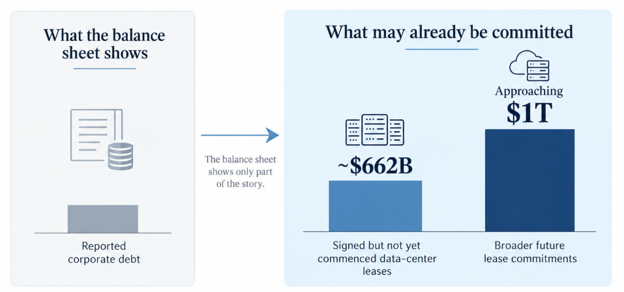
Michael Burry (the Big Short guy) has taken the analysis further, estimating that lease commitments, purchase agreements, and other contractual obligations across the five largest hyperscalers may approach $3 trillion. Those are big numbers so the concern is that traditional balance-sheet debt likely captures only part of the capital already committed to this buildout, making visibility and analysis somewhat of a guessing game.
There is another wrinkle if the cycle eventually slows. Ares estimates that roughly 60 cents of every dollar of AI infrastructure investment goes into chips and hardware, compared with roughly 25 cents for power and cooling and only 15 cents for land and buildings. Those assets have very different economic lives and recovery values. Advanced computing hardware can lose economic value far faster than the liabilities funding it disappear. In other words, the collateral used to underwrite loans could be a riskier bet than what is currently being priced if enthusiasm cools.
The structural risks are becoming easier to identify. The harder question is what eventually exposes them. Bear Stearns and Lehman Brothers did not create the leverage and interconnected exposures that preceded the Global Financial Crisis. Their failures exposed vulnerabilities that had already accumulated. In addition, just before the GFC kicked off, the U.S. unemployment rate was sitting at 4.8% and Wall Street analysts were expecting mid-double-digit earnings growth over the next 12 months.
We increasingly wonder whether a similar type of event could become the trigger for the AI ecosystem. We do not mean that AI resembles the banking system in 2008, nor are we predicting the failure of any particular company. The point is that one important participant could get ahead of its skis, allowing the mismatch between its assets, liabilities, capital commitments, and expected future cash flows to become too large to manage comfortably. In an ecosystem this interconnected and concentrated, a problem at one important company could force lenders, investors, suppliers, customers, and counterparties to reassess risks that previously appeared unrelated.
The management challenge is also worth thinking about. The largest technology companies have exceptional leadership teams and deep financial resources, but even they have never been asked to deploy capital at anything resembling the current pace while navigating such rapid technological change. The challenge may be even greater for leading private model developers such as OpenAI and Anthropic, which have grown from relatively small organizations into institutions of enormous financial and strategic importance in only a few years.
Navigating this environment is a tall task, particularly when technological development, fundraising, infrastructure commitments, regulation, talent, partnerships, and geopolitical competition all need to be managed simultaneously.
The area we would watch most closely is therefore not whether AI suddenly stops improving. It is whether one important player creates an asset-liability mismatch that becomes difficult to unwind. A company could commit to years of compute, leases, power, data centers, or supplier obligations based on assumptions about future revenue and continued access to financing. If those assumptions change before the underlying assets generate the expected cash flow, the problem can become financial very quickly.
Then there are the physical constraints. AI requires enormous amounts of power, land, transmission, cooling, water, and construction. As the buildout becomes more visible, data centers are also becoming a larger local political issue ahead of the midterm elections, particularly around electricity prices, grid infrastructure, tax incentives, land use, and water consumption. The risk is not that politics suddenly stops AI development. It is that permitting, power availability, regulation, or local opposition make projects more expensive or slower to complete, with potential consequences for the leases, financing arrangements, supplier commitments, and guarantees built around them.
History suggests that is usually unrealistic to identify the exact catalyst in advance, but we’re still going to try. At the very least, what we can do is continue working to understand where the mismatches are building, which companies have become critical to the ecosystem, and how a problem at one could transmit to others.
There are still plenty of reasons to be constructive on the economy. Growth remains healthy, corporate earnings are strong, household wealth is high, and AI investment continues to expand. These are not the conditions we would normally associate with an economy about to fall into recession.
Our concern is more about the market setup. Several forces that helped support 2026 should become less helpful next year. Interest rates are higher, fiscal support is likely fading, energy costs remain elevated, the bar for AI investment is rising, and refinancing pressure will gradually reach more households and companies. At the same time, the strongest parts of the economy and market are increasingly connected to two powerful forces: AI investment and the spending of wealthier households whose balance sheets have benefited from rising asset values.
That leaves us with an interesting problem. The S&P 500 may be relatively insulated from some of the pressures because its largest companies are highly profitable and central to the AI investment cycle. Yet the same concentration that provides insulation could become a vulnerability if the investment engine slows. AI does not need to collapse for that to matter. A transition from extraordinary growth to merely good growth could be enough to change earnings expectations, financing conditions, and investor sentiment.
This is what makes the portfolio decision difficult. Nothing is clearly broken. Significantly reducing exposure to AI-related companies could prove costly if the current cycle continues, just as moving materially into cash could create a meaningful opportunity cost if markets remain strong.
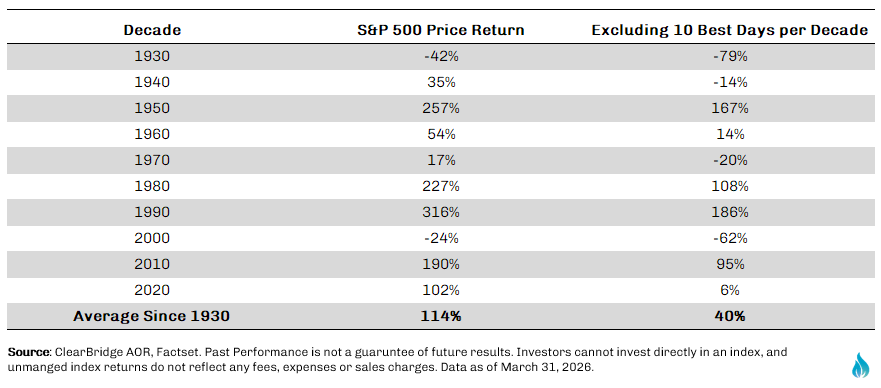
Our approach has been to broaden portfolios rather than pull back from markets. Over the past 12 months, we have increased international exposure, adjusted SMID-cap allocations, and added equal-weight S&P 500 exposure. The equal-weight position was not simply a hedge against mega-cap concentration. It also reflected our expectation that earnings growth could broaden and that a wider group of companies could benefit from stronger growth and secular themes such as U.S. manufacturing investment and onshoring. We have also used gold tactically as a diversifier against policy, geopolitical, and economic uncertainty.
The current environment now calls for another recalibration. Where equity markets have pushed client portfolios above their strategic targets, we have been rebalancing back toward appropriate ranges. We also expect to continue adjusting equity exposures at the margin, particularly in areas that are more sensitive to another higher-for-longer interest-rate environment.
Fixed income is becoming a more useful part of that process. Yields across high-quality bonds are among the most attractive we have seen in more than two decades. Rates can certainly move higher from here, but the income available today provides a much better cushion than when yields were near historic lows.
We are also reviewing hedging strategies that may allow us to maintain exposure to attractive long-term opportunities, including AI, while providing additional protection if conditions unwind more quickly than expected. The goal is not to eliminate risk or become overly conservative. It is to be more intentional about which risks we are being paid to take and which we may be able to reduce more efficiently.
For us, 2027 increasingly looks like a year where getting the details right may matter more than simply getting the direction of the economy right.

Michael is the founder of Fire Capital Management.