Written by
Alyssa Heath, CAP
Written by
Alyssa Heath, CAP
Published on
November 12, 2026
Category
Impact

As we enter the final months of 2026, it's a good time to reflect on the causes and organizations that matter most to us. Whether you've been giving throughout the year or have a few charitable contributions still on your to-do list, year-end is an opportunity to be thoughtful about where and how you want to make a difference.
At Fire Capital Management, we believe philanthropy is an opportunity to put your values into action and create lasting positive impact. With that in mind, here are a few considerations to help you give more intentionally, take advantage of available planning opportunities, and support the causes that matter most to you.
Start by reflecting on the organizations and causes you've supported this year. Are there nonprofits you'd like to support again? New initiatives or community needs you'd like to contribute to?
Whether you're exploring a new cause area or looking to deepen your support for existing organizations, consider reaching out to nonprofits to learn more about their current priorities and needs.
For many organizations, unrestricted contributions can be especially valuable, providing the flexibility to direct resources where they're needed most. Meaningful philanthropy isn't always about giving more. It can also mean giving more intentionally and building stronger relationships with the organizations you support.
If you're planning additional charitable contributions before year-end, consider both the assets you give and the charitable giving strategies available to you. Choosing the right approach can help make your giving more tax-efficient while supporting your philanthropic goals.
Appreciated Securities: Donating long-term appreciated securities directly to a qualified charity or donor-advised fund (DAF) can be more tax-efficient than selling those securities and donating the proceeds. Eligible gifts may allow donors to avoid realizing embedded capital gains while potentially receiving a charitable deduction based on fair market value, subject to applicable limitations.
Donor-Advised Funds (DAF): A DAF is a charitable giving account that allows you to contribute assets, receive a tax deduction if eligible, and recommend grants to qualified charities. Contributions can be invested and grow tax-free. Donors can contribute as frequently as they like and recommend grants when opportunities or needs arise, providing flexibility to give when it makes financial sense and support nonprofits when it matters most.
Qualified Charitable Distributions (QCD): For individuals age 70½ or older, a QCD offers another tax-efficient way to give. In 2026, eligible donors can transfer up to $111,000 directly from an IRA to a qualifying charity, generally excluding the distribution from taxable income. QCDs are available even if you're not yet required to take minimum distributions (RMDs), and for those who are (generally age 73 or older), QCDs can satisfy all or part of that requirement. Contributions to DAFs are not eligible for QCD treatment.
See QCD example below:
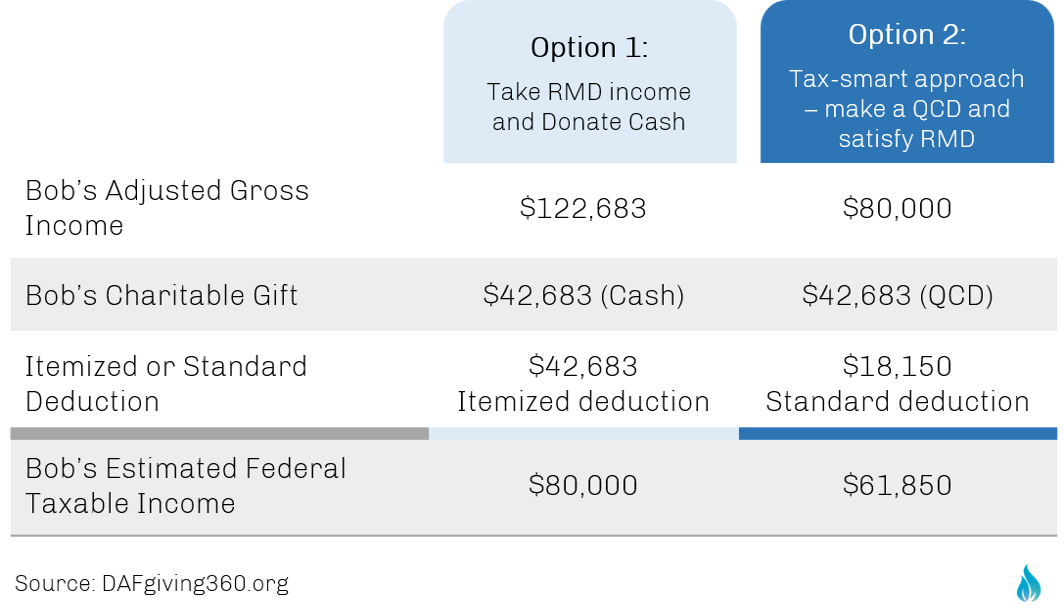
Bob, age 75, has a RMD of $42,683 from his traditional IRA in 2026. If he withdraws the funds and donates them to charity, his adjusted gross income (AGI) increases to $122,683, but an itemized charitable deduction could reduce his federal taxable income to $80,000. Alternatively, by directing his RMD to an eligible charity through a QCD, the distribution is excluded from his taxable income. This allows Bob to claim the standard deduction of $18,150, reducing his federal taxable income to $61,850 and providing a more tax-efficient giving strategy.
Several provisions of the One Big Beautiful Bill Act (OBBBA) took effect in 2026, making it especially important for donors to consider how the new rules may affect their charitable contributions before year-end and their giving strategies for 2027 and beyond.

New 0.5% AGI deduction floor: For taxpayers who itemize, charitable contributions are generally deductible only to the extent they exceed 0.5% of adjusted gross income (AGI). This may make it worthwhile to consider bunching multiple years of charitable contributions into a single tax year, particularly during higher-income years.
A DAF can be a useful tool for this strategy, allowing donors to make a larger contribution in one year while continuing to recommend grants to their favorite nonprofits over subsequent years.
35% maximum marginal tax benefit: Taxpayers in the highest federal income tax bracket generally face a reduced tax benefit from itemized deductions, with the maximum marginal benefit limited to 35%.
New deduction for non-itemizers: Individuals taking the standard deduction may now deduct up to $1,000, or $2,000 for married couples filing jointly, for qualifying cash gifts to eligible charities. Contributions to DAFs are excluded.
Deduction limits: The 60%-of-AGI deduction limit for cash contributions to qualifying public charities, including DAF sponsors, is now permanent, while the general limit for long-term appreciated securities remains 30% of AGI.
For donors eligible to make QCDs, these distributions may be especially attractive under the new rules. Because qualifying QCDs are generally excluded from taxable income rather than claimed as itemized deductions, they are not subject to the new 0.5% AGI floor.
These changes reinforce the importance of considering both what you give and when you give, alongside your broader financial and philanthropic goals. For additional background, see our Mid-Year Philanthropic Planning: Maximizing Your Impact article.
While December 31 marks the end of the tax year, financial institutions and charitable giving platforms often have earlier processing guidelines.
If you're planning to contribute appreciated securities or fund a DAF, it's important to begin the process early. To qualify for a potential 2026 charitable deduction, your DAF contribution generally must be completed by December 31, 2026. However, grants from the DAF to nonprofit organizations can be recommended in future years without affecting the timing of the original contribution's deduction.
Similarly, QCDs must be completed by December 31, 2026, to count for this tax year. Because processing times vary, eligible donors should coordinate with their IRA custodians well in advance of the deadline.
Planning ahead can help avoid last-minute processing delays and ensure your contributions are completed within the intended tax year. For nonprofits, receiving donations earlier or having a clearer sense of expected support can help them plan their budgets, programs, and resources for the upcoming year.
Year-end giving can also be an opportunity to reflect on the longer-term impact you'd like to create.
Perhaps you're interested in exploring a new cause, deepening your relationships with organizations you've supported for years, or developing a giving strategy that evolves alongside your priorities. You may also want to involve family members or loved ones in your philanthropic decisions or consider the legacy you'd like your giving to create.
It's also worth remembering that philanthropy extends beyond financial contributions. Your time, talents, voice, and connections can be just as meaningful to the organizations and causes you care about. Whether it's volunteering, sharing your expertise, raising awareness, or connecting nonprofits with valuable resources and relationships, there are many ways to make a difference.
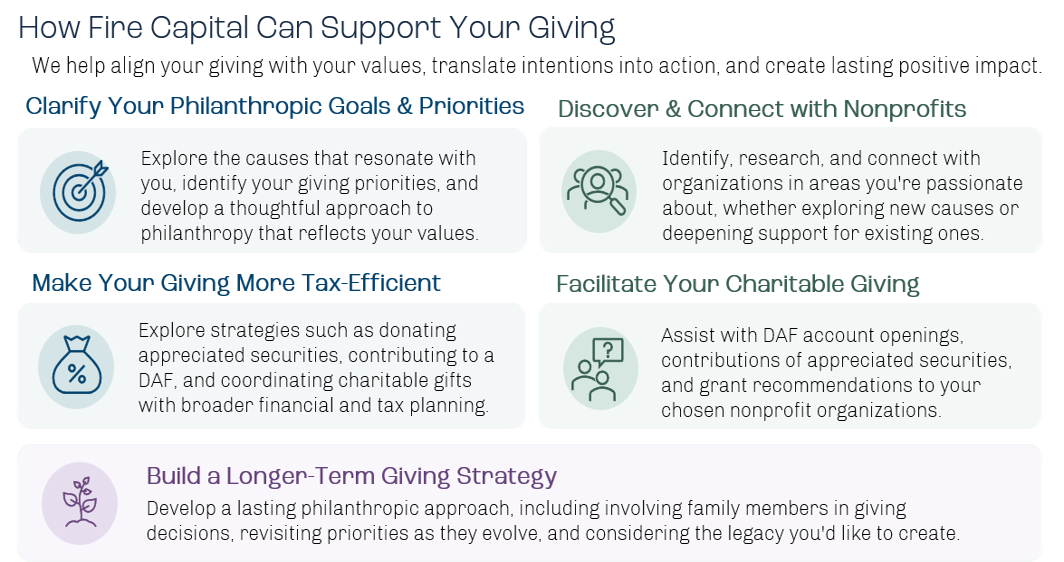
At Fire Capital, we believe meaningful philanthropy begins with understanding what matters most to you. As a trusted partner in your philanthropic journey, we help clients clarify their giving priorities, identify and connect with nonprofit organizations working in areas they're passionate about, and translate their intentions into action.
We also support clients with charitable giving strategies, donor-advised funds, and longer-term philanthropic planning, helping them align their financial resources with their values and create lasting positive impact.
As the year comes to a close, we encourage you to reflect on the difference you'd like to make and the many ways you can contribute, both today and in the years ahead.
If you're considering year-end contributions, exploring new charitable organizations, or looking to bring greater intention to your philanthropy, we'd welcome the opportunity to connect.
This article is for informational purposes only and is not intended as tax or legal advice. Charitable deduction eligibility and limitations depend on individual circumstances. Consult your tax or legal advisor regarding your specific situation.
Sources
https://www.dafgiving360.org/tax-law-changes
https://www.dafgiving360.org/giving-with-ira